
LSTM-based Classifier for Counter-Battery Radars
LSTM-based Classifier for Counter-Battery Radars
A neural network classifier to help counter-battery radars quickly distinguish between ballistic projectiles and other clutters (birds, airplanes, false detections, etc.).
Key Highlights
- Achieved 94.3% accuracy and 0.85 F1-score on real-world data collected by counter-battery radars.
- Patent granted (10-2641022-0000) in Korea as the property of the Republic of Korea Army.
Objective
The goal for this model is to be used as a light-weight first-layer filter for counter-battery radars. The model must prioritize high recall and short runtime.
Available input: coordinates of the trajectory, radar cross section (RCS), signal-to-noise ratio, radial velocity, etc.
Output: a value in [0,1] range (0 for clutter, 1 for projectile).
Existing Study
An existing study by Koh et al. [1] used a two-layer LSTM model with dropout layers, and experimented with the following four cases of input features.
Given the target’s location (east, north, up) at time \(t\) is denoted as \(e_t\), \(n_t\), \(u_t\)
- Case 1: \(e_t\), \(n_t\), \(u_t\), radial velocity, RCS
- Case 2: \(\Delta e_t\), \(\Delta n_t\), \(\Delta u_t\), radial velocity, RCS
- Case 3: \(e_t / n_t\), radial velocity, RCS
- Case 4: \(\Delta (e_t / n_t)\), radial velocity, RCS
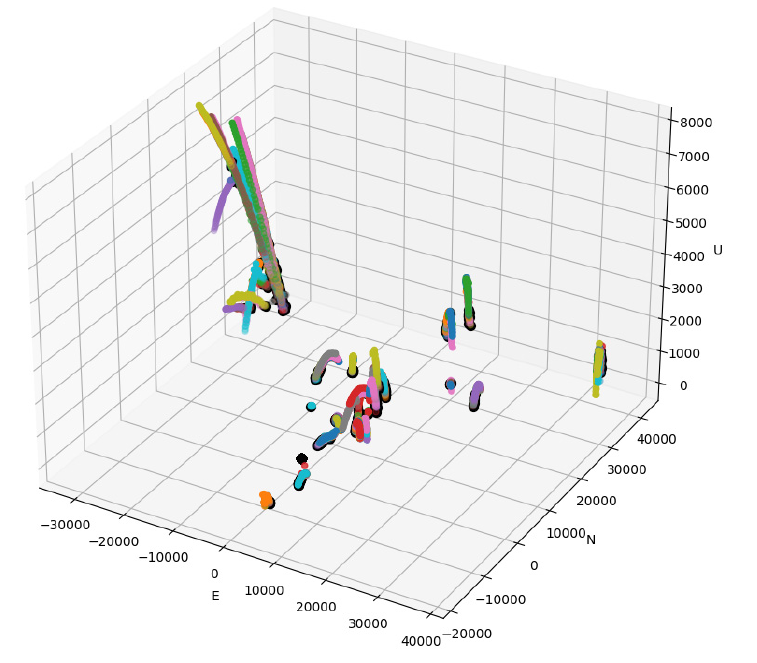
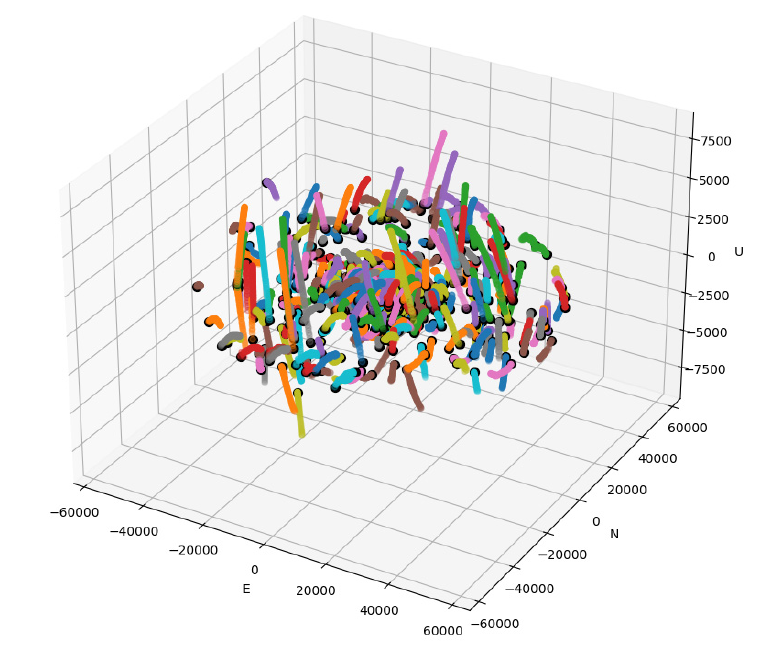
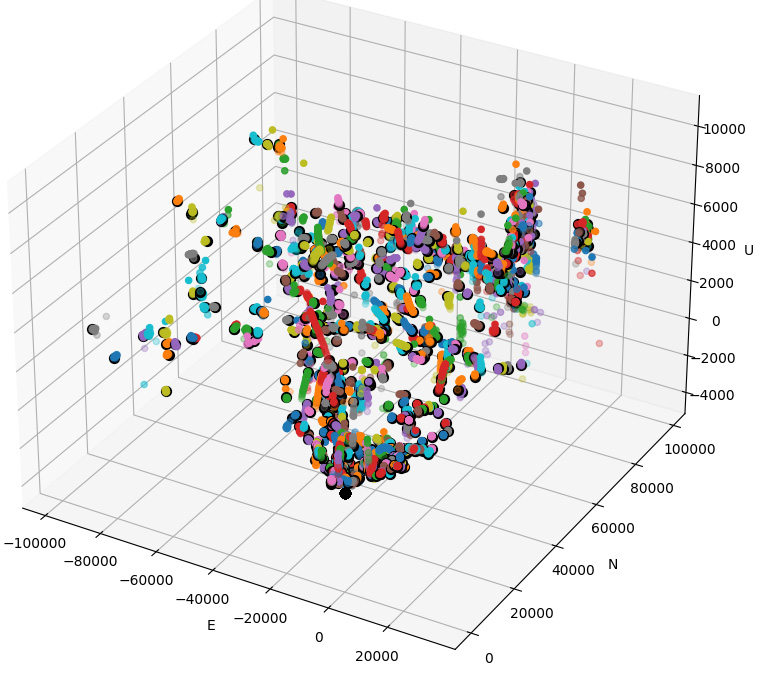
Upon trying to replicate the study’s results, we found that these models perform well (about 95% accuracy and 0.88 f1-score) when tested on unaugmented data ().
However, we found that these models do not generalize well to data with random augmentations in the trajectory direction (). The model performances dropped to about 60% accuracy when being trained/ tested on the augmented dataset.
Methodology
To keep the input feature invariant to trajectory direction, the following features are instead chosen for the model, \(\Delta u\), and \(a_t\).
Change in trajectory angle (\(a_t\)) and change in altitude (\(\Delta u_t\)) can be computed using the following formula.
Given that the position of the target (east, north up) at times \(t-1\), \(t\), \(t+1\) are denoted as \((e_{t-1}, n_{t-1}, u_{t-1})\), \((e_t, n_t, u_t)\), \((e_{t+1}, n_{t+1}, u_{t+1})\) respectively,
\[v_t = [ e_t - e_{t-1} , n_t - n_{t-1} , u_t - u_{t-1} ]\] \[v_{t+1} = [ e_{t+1} - e_t , n_{t+1} - n_t , u_{t+1} - u_t ]\] \[a_t = \arccos(\frac{v_t \cdot v_{t+1}}{|v_t| |v_{t+1}|})\] \[\Delta u_t = u_t - u_{t-1}\]The model structure is kept the same as [1], a two-layer LSTM with a dropout layer in between.
To reduce computation time, only the first 13 data points in the sequence are used as input to the model.
Results
- 94.3% accuracy with 0.85 F1-score.
- 0.623 precision @ 0.98 recall.
- 0.813 precision @ 0.96 recall.
Limitations and Future Work
- The network needs to be robust against missing data points in the trajectory. Different interpolation methods and their effect on the input features are worth exploring. Incorporating \(dt\) or positional embedding into the inputs may be an alternative to requiring interpolation for missing data points.
- The model can be extended to multi-class classification, classifying the different types of ballistic projectiles or the different types of clutters (e.g. drones).
- A transformer-based model with a similar number of parameters performed slightly worse (93.69% accuracy with 0.7899 F1-score) than the LSTM-based model. It is worth exploring how transformer-based models perform in comparison to LSTM-based models under varying circumstances (e.g. longer input sequences, greater noise, etc.).
Patent
Based on this study, we got a patent granted in Korea as the property of Republic of Korea Army.
- Patent name: Artificial Intelligence-Based Target Classification Method and System For Counter-Battery Radar (인공지능 기반 대포병탐지레이더 표적분류 방법 및 시스템)
- Korean Patent Number: 10-2641022-0000
References
[1] I.-S. Koh, H. Kim, S.-H. Chun, and M.-K. Chong, ‘Efficient Recurrent Neural Network for Classifying Target and Clutter: Feasibility Simulation of Its Real-Time Clutter Filter for a Weapon Location Radar’, Journal of Electromagnetic Engineering and Science, vol. 22, no. 1, pp. 48–55, 2022.